Posts

Comparison of Richard (The Hours) and Septimus (Mrs. Dalloway)

Image
  The Death of Marat  by Jacques-Louis David In Clarissa’s storyline in The Hours , several characters from Mrs. Dalloway are combined into Richard Dalloway’s character. Richard seems to be an amalgamation of Richard, of course, Septimus, and Peter (or at least Peter’s role as the romanticized ex). Richard’s character in The Hours clearly draws inspiration from Septimus, as Richard is a poetic writer who eventually meets the same fate Septimus does in Mrs. Dalloway —suicide. The nature of Richard’s suicide in The Hours in some ways stays true to the novel, however in other ways, the original points that Virginia Woolf makes in Septimus’s story are lost. One similarity between the stories of both characters is the fact that they are essentially kept alive by the women in their lives for the durations of their stories before their suicides. In The Hours , Richard is taken care of by Clarissa, and even says that he stays alive for as long as he does “just to satisfy” Clariss...

Cohn vs. Mike

Image
  Two Soldiers on Horseback by Horace Vernet Despite Ernest Hemingway’s straightforward and simple style of writing, there is a lot of ambiguity in the relationships between characters in The Sun Also Rises . One of the relationships riddled with unanswered questions is that of Jake and Brett. Jake clearly is in love with Brett, but underneath the surface are complex and conflicted feelings about her. He seems frustrated, saddened, and conflicted about his situation with Brett, and these feelings are further complicated when other men express interest in Brett, namely Robert Cohn. Jake seems relatively okay with the fact that Brett is going to marry Mike, but he becomes intensely jealous upon discovering that Brett and Cohn had a thing. So, what is the difference between Mike and Cohn to Jake? One of the differences between Mike and Cohn are the circumstances of their relations with Brett. Mike is going to marry Brett, and Cohn takes a trip with her. Jake believes that Brett’s pa...

Clarissa's Opinion on Mental Health Professionals

Image
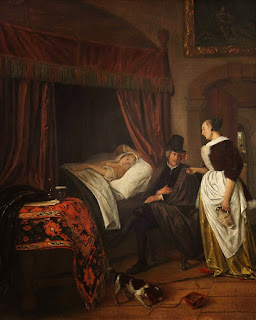
    The Doctor's Visit by Jan Steen                  Throughout Mrs. Dalloway , the so-called mental health professionals of the time are portrayed in a very negative light. Septimus abhors Dr. Holmes, referring to him as “Human Nature” which Septimus views as inherently evil. Dr. Holmes, despite his assumption that he knows best, does nothing to help Septimus and instead further pushes him over the edge. Sir William Bradshaw, though more helpful than Holmes considering he actually believes Septimus is mentally ill, also ultimately makes matters worse by attempting to force Septimus to live away from Lucrezia. Woolf makes it explicit that the added stress of these looming doctors that ignore the feelings of their patient is part of what drives Septimus to commit suicide, suggesting a deep contempt of the doctors Woolf encountered in her own life.             After finishi...

Clarissa's Dissatisfaction

Image
  It has become apparent to us as readers that Clarissa Dalloway seems unsure whether she has made the best decisions in her life. We see this doubt mainly when she reminisces about her past relationship with Peter Walsh, and when she kisses Peter upon his return to England. I believe that Clarissa ultimately would be happier if she had made decisions which led her to a different kind of life. This is not to say that she would have necessarily been happier with Peter, but there are many aspects of Clarissa’s personality and life that suggest deep dissatisfaction. The main indicator of Clarissa’s dissatisfaction is her insecurity about her choice of marriage. She never once thinks about Richard with the same enthusiasm as when she thinks about Peter or Sally Seton. In fact, Clarissa thinks about him so little that we hardly know anything about Richard from just Clarissa’s thoughts. She even explicitly indicates that she has had conscious second thoughts after she kisses Peter and ...

Transience in The Mezzanine

Image
                In my first blog post, I would like to examine the ways that I think Howie’s narration his life fits into Aurelius’ idea of the transience of life, and also the ways that it doesn’t.             We know that Howie disliked Aurelius’ view of life. However, despite Howie’s protests to this view that life is fleeting and trivial, I think that much of The Mezzanine supports this idea. Howie obviously has a strong fixation on man-made products. In his detailed descriptions of various types of machinery or products, he often talks about how they have changed over time, or when they first emerged. Like in the case of milk delivery, he may even reminisce about the end of these products. Additionally, Howie sometimes talks about things that, as readers born in the early 2000s, we cannot relate to because they don’t exist anymore. My favorite example of this occurs when Howie is talk...