Posts

Sethe, Beloved, and Grief
Image
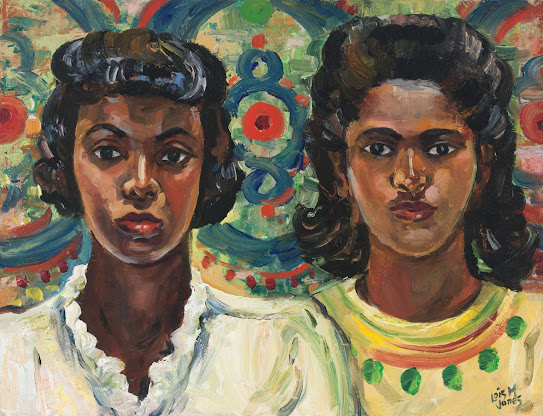
  Portrait of Two Women  by Lo ïs Mailou Jones (c. 1950) Throughout Beloved , important information is kept ambiguous to the reader until methodically revealed, gradually creating a full picture of each of the characters’ lives and experiences (at least ones important to the story)—that is, except for in the case of Beloved. Beloved’s reemergence into the world and her final departure are both largely left to the imagination of the reader. So is the meaning of Beloved’s reappearance in Sethe’s and Denver’s lives, which is the subject of this blog post. I certainly don’t think that there is a single definitive reason for Beloved’s return, but wondering about possible purposes of her character lead me to think about the relation between Beloved and Sethe’s grief for her.             Sethe acts completely unapologetic about killing Beloved in order to save her from going back to Sweet Home. Even when faced with her neighbor...
Not a Fan of Mr. Cake

Image
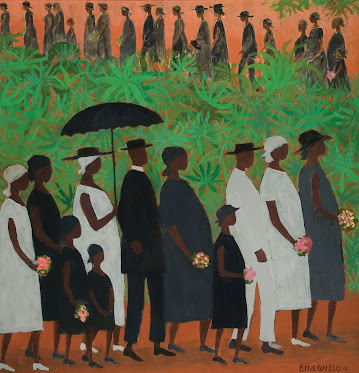
              Funeral Procession  by Ellis Wilson (c. 1950) While reading Their Eyes Were Watching God , I felt as though the novel went from being a story about Janie to one centered around her relationship with Tea Cake. I find it odd how much focus his character gets, and the positive, loving nature with which Janie speaks and thinks about Tea Cake up to the end of the novel, because I personally thought there were a lot of parallels between Janie’s relationship with Tea Cake and her past soured relationships. There are certainly key differences between Tea Cake and the husbands who came before him. His and Janie’s relationship, which develops from a natural chemistry uninfluenced by finances, seems almost like the young love that Janie wanted but missed out on, and Tea Cake actually seems to care about Janie’s happiness. To Janie, these things clearly make all the difference, which is understandable at first. However, Tea Cake’s red fla...

Fighting Invisibilty?

Image
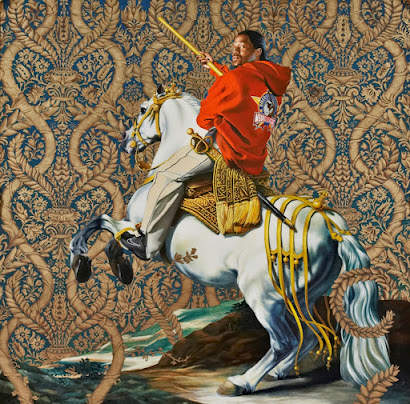
Equestrian Portrait of the Count Duke Olivares  by Kehinde Wiley (2005) Having now finished Invisible Man , I find that there is an aspect of the novel that I am conflicted about and have been since the prologue: the narrator’s acceptance of his invisibility. In the prologue, when the narrator is first introducing the concept of invisibility, he says, “I am not complaining, not am I protesting either. It is sometimes advantageous to be unseen, although it is most often rather wearing on the nerves” (3). I find this passage interesting because the narrator is explicit about the hardships of being invisible (and then proceeds to write a whole book about them), but he also seems rather accepting of his invisibility. On one hand, I think it would be impossible for the narrator to be “visible.” His invisibility is completely out of his control and has entirely to do with the fact that he is a black man living in a racist society. Additionally, before discovering his invisibility, the ...

The Narrator and History

Image
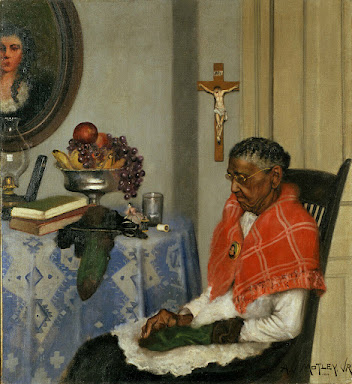
  Mending Socks  by Archibald Motley Jr. (1924) Though as of the last reading the narrator is still involved in the Brotherhood, he has become increasingly disenchanted with the organization, especially after Clifton’s death. However, he is hesitant to leave the Brotherhood because “it [is] the only historically meaningful life that [he] could live” and he has “lost too much” of himself to go back to being who he was before he found the Brotherhood (478). Though the latter reason is important as it pertains to the theme of identity in this novel, for the purposes of this blog post I am interested in exploring the narrator’s concern with the idea of being “historically meaningful.” The narrator’s desire to be remembered in history seems closely related to his ambitious nature and desire to climb to the top of anything he pursues. Throughout the novel the narrator has had a deep desire that he has yet to shake, which is to be powerful in a way that allows him to be visible to ...

The Narrator's Southern Identity

Image
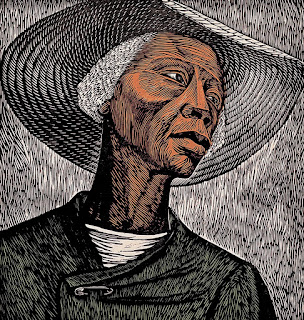
  Sharecropper  by Elizabeth Catlett (1952) In recent chapters of Invisible Man , the narrator has called his identity into question. As his consciousness has developed (and since he had a lobotomy-like medical procedure performed on him), he has begun to question who he is and the anxieties which seemed to define his consciousness earlier in the novel. A particular aspect of the narrator’s identity which has also been discussed in recent chapters is that of his southern roots. The narrator initially seems ashamed of his southern identity. We see this most clearly in the scene where he goes into a diner, and proudly denies the server’s suggestion that he would like a traditional southern breakfast. The narrator thinks to himself, “Could everyone see that I was southern?”, clearly self-conscious about being perceived as southern, and views his ordering of an orange juice, toast, and coffee as “an act of discipline, a sign of the change that was coming over me and which would ...

Representation of Black Women in Native Son

Image
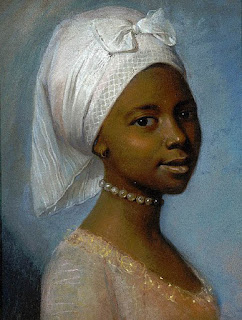
Portrait of a Young Woman - artist unknown, late 18th century                The blind spot in Native Son most discussed in class was that of the book’s representation of Bessie and black women as a whole, and whether this representation is effective in its depiction of the experiences of black women. To make a blanket statement, none of the women in Native Son are developed enough as characters to be depicted as full, well-rounded people. However, Bessie gets the brunt of this flat representation as she is objectified, dehumanized, and devalued by Bigger throughout the book, and then is literally treated as an object as her body is brought out as evidence in court for the murder of a white woman. I think it can be argued that there are reasons for this lacking depiction of Bessie, but I do not think that this novel is at all an effective representation of what it is like to be a black woman.        ...

Start of African American Lit. Posts

 From this point on all blog posts are related to African American Lit.

Free Will in The Plague

Image
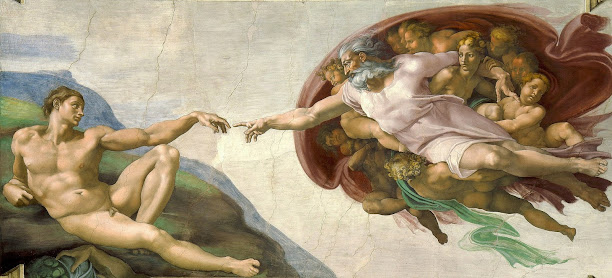
  The Creation of Adam by Michelangelo (c. 1508-1512) There have been many different responses to the plague. Some townspeople have chosen to essentially ignore it and wait for it to pass, some have decided to help fight the plague, and some have set their houses on fire. The way different characters have reacted reveal a lot about their worldviews. In Paneloux’s case, he has decided to give sermons about the plague, stating that the plague is part of God’s unwavering plan. Meanwhile Tarrou has set out to help the health committees control the spread of the plague, showing that he believes human efforts can save lives. I find Paneloux’s and Tarrou’s viewpoints particularly interesting, as they seem polarizing, and get into the question of whether the people on The Plague have free will. As Paneloux says in his sermons, he firmly believes that the plague is God’s will and that God’s will must be accepted in its entirety or fought in its entirety—there cannot be any middle ground. ...

A Comparison of The Plague to Corona Virus

Image
  The Triumph of Death  by Pieter Bruegel the Elder (1562) There are a lot of passages in The Plague that feel eerily familiar considering our current circumstances. From the fact that the characters are unsure what the illness in Oran is and what it is capable of, to the authorities in the town hesitating to reveal the dangers of the illness to the townspeople, it feels like a novel based on the year 2020. Two passages from this reading in particular struck me as being very true to what we are seeing happen in the United States. The first passage occurs shortly after Rieux admits that the disease in Oran is likely a plague, and he begins to think about the death tolls of plagues: “Figures floated across [Rieux’s] memory, and he recalled that some thirty or so great plagues known to history had accounted for nearly a hundred million deaths. But what are a hundred million deaths? […] since a dead man has no substance unless one has actually seen him dead, a hundred million cor...

Comparison of Richard (The Hours) and Septimus (Mrs. Dalloway)

Image
  The Death of Marat  by Jacques-Louis David In Clarissa’s storyline in The Hours , several characters from Mrs. Dalloway are combined into Richard Dalloway’s character. Richard seems to be an amalgamation of Richard, of course, Septimus, and Peter (or at least Peter’s role as the romanticized ex). Richard’s character in The Hours clearly draws inspiration from Septimus, as Richard is a poetic writer who eventually meets the same fate Septimus does in Mrs. Dalloway —suicide. The nature of Richard’s suicide in The Hours in some ways stays true to the novel, however in other ways, the original points that Virginia Woolf makes in Septimus’s story are lost. One similarity between the stories of both characters is the fact that they are essentially kept alive by the women in their lives for the durations of their stories before their suicides. In The Hours , Richard is taken care of by Clarissa, and even says that he stays alive for as long as he does “just to satisfy” Clariss...

Cohn vs. Mike

Image
  Two Soldiers on Horseback by Horace Vernet Despite Ernest Hemingway’s straightforward and simple style of writing, there is a lot of ambiguity in the relationships between characters in The Sun Also Rises . One of the relationships riddled with unanswered questions is that of Jake and Brett. Jake clearly is in love with Brett, but underneath the surface are complex and conflicted feelings about her. He seems frustrated, saddened, and conflicted about his situation with Brett, and these feelings are further complicated when other men express interest in Brett, namely Robert Cohn. Jake seems relatively okay with the fact that Brett is going to marry Mike, but he becomes intensely jealous upon discovering that Brett and Cohn had a thing. So, what is the difference between Mike and Cohn to Jake? One of the differences between Mike and Cohn are the circumstances of their relations with Brett. Mike is going to marry Brett, and Cohn takes a trip with her. Jake believes that Brett’s pa...

Clarissa's Opinion on Mental Health Professionals

Image
    The Doctor's Visit by Jan Steen                  Throughout Mrs. Dalloway , the so-called mental health professionals of the time are portrayed in a very negative light. Septimus abhors Dr. Holmes, referring to him as “Human Nature” which Septimus views as inherently evil. Dr. Holmes, despite his assumption that he knows best, does nothing to help Septimus and instead further pushes him over the edge. Sir William Bradshaw, though more helpful than Holmes considering he actually believes Septimus is mentally ill, also ultimately makes matters worse by attempting to force Septimus to live away from Lucrezia. Woolf makes it explicit that the added stress of these looming doctors that ignore the feelings of their patient is part of what drives Septimus to commit suicide, suggesting a deep contempt of the doctors Woolf encountered in her own life.             After finishi...

Clarissa's Dissatisfaction

Image
  It has become apparent to us as readers that Clarissa Dalloway seems unsure whether she has made the best decisions in her life. We see this doubt mainly when she reminisces about her past relationship with Peter Walsh, and when she kisses Peter upon his return to England. I believe that Clarissa ultimately would be happier if she had made decisions which led her to a different kind of life. This is not to say that she would have necessarily been happier with Peter, but there are many aspects of Clarissa’s personality and life that suggest deep dissatisfaction. The main indicator of Clarissa’s dissatisfaction is her insecurity about her choice of marriage. She never once thinks about Richard with the same enthusiasm as when she thinks about Peter or Sally Seton. In fact, Clarissa thinks about him so little that we hardly know anything about Richard from just Clarissa’s thoughts. She even explicitly indicates that she has had conscious second thoughts after she kisses Peter and ...

Transience in The Mezzanine

Image
                In my first blog post, I would like to examine the ways that I think Howie’s narration his life fits into Aurelius’ idea of the transience of life, and also the ways that it doesn’t.             We know that Howie disliked Aurelius’ view of life. However, despite Howie’s protests to this view that life is fleeting and trivial, I think that much of The Mezzanine supports this idea. Howie obviously has a strong fixation on man-made products. In his detailed descriptions of various types of machinery or products, he often talks about how they have changed over time, or when they first emerged. Like in the case of milk delivery, he may even reminisce about the end of these products. Additionally, Howie sometimes talks about things that, as readers born in the early 2000s, we cannot relate to because they don’t exist anymore. My favorite example of this occurs when Howie is talk...