Posts

Not a Fan of Mr. Cake
Image
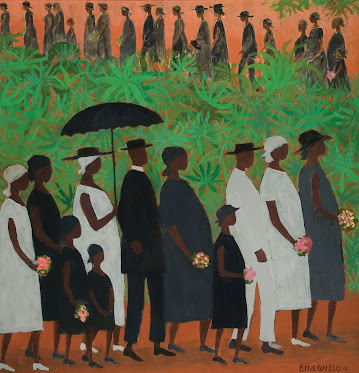
              Funeral Procession  by Ellis Wilson (c. 1950) While reading Their Eyes Were Watching God , I felt as though the novel went from being a story about Janie to one centered around her relationship with Tea Cake. I find it odd how much focus his character gets, and the positive, loving nature with which Janie speaks and thinks about Tea Cake up to the end of the novel, because I personally thought there were a lot of parallels between Janie’s relationship with Tea Cake and her past soured relationships. There are certainly key differences between Tea Cake and the husbands who came before him. His and Janie’s relationship, which develops from a natural chemistry uninfluenced by finances, seems almost like the young love that Janie wanted but missed out on, and Tea Cake actually seems to care about Janie’s happiness. To Janie, these things clearly make all the difference, which is understandable at first. However, Tea Cake’s red fla...
Fighting Invisibilty?

Image
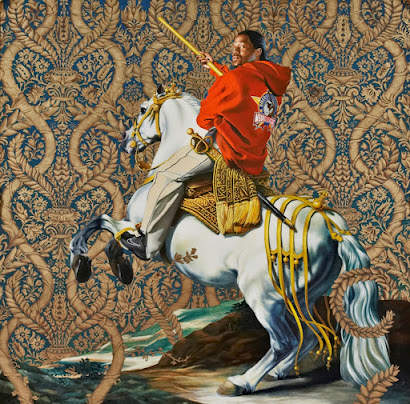
Equestrian Portrait of the Count Duke Olivares  by Kehinde Wiley (2005) Having now finished Invisible Man , I find that there is an aspect of the novel that I am conflicted about and have been since the prologue: the narrator’s acceptance of his invisibility. In the prologue, when the narrator is first introducing the concept of invisibility, he says, “I am not complaining, not am I protesting either. It is sometimes advantageous to be unseen, although it is most often rather wearing on the nerves” (3). I find this passage interesting because the narrator is explicit about the hardships of being invisible (and then proceeds to write a whole book about them), but he also seems rather accepting of his invisibility. On one hand, I think it would be impossible for the narrator to be “visible.” His invisibility is completely out of his control and has entirely to do with the fact that he is a black man living in a racist society. Additionally, before discovering his invisibility, the ...

The Narrator and History

Image
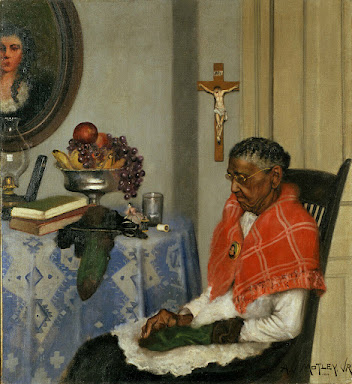
  Mending Socks  by Archibald Motley Jr. (1924) Though as of the last reading the narrator is still involved in the Brotherhood, he has become increasingly disenchanted with the organization, especially after Clifton’s death. However, he is hesitant to leave the Brotherhood because “it [is] the only historically meaningful life that [he] could live” and he has “lost too much” of himself to go back to being who he was before he found the Brotherhood (478). Though the latter reason is important as it pertains to the theme of identity in this novel, for the purposes of this blog post I am interested in exploring the narrator’s concern with the idea of being “historically meaningful.” The narrator’s desire to be remembered in history seems closely related to his ambitious nature and desire to climb to the top of anything he pursues. Throughout the novel the narrator has had a deep desire that he has yet to shake, which is to be powerful in a way that allows him to be visible to ...

The Narrator's Southern Identity

Image
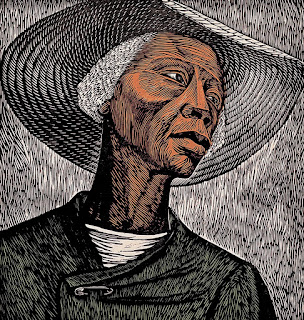
  Sharecropper  by Elizabeth Catlett (1952) In recent chapters of Invisible Man , the narrator has called his identity into question. As his consciousness has developed (and since he had a lobotomy-like medical procedure performed on him), he has begun to question who he is and the anxieties which seemed to define his consciousness earlier in the novel. A particular aspect of the narrator’s identity which has also been discussed in recent chapters is that of his southern roots. The narrator initially seems ashamed of his southern identity. We see this most clearly in the scene where he goes into a diner, and proudly denies the server’s suggestion that he would like a traditional southern breakfast. The narrator thinks to himself, “Could everyone see that I was southern?”, clearly self-conscious about being perceived as southern, and views his ordering of an orange juice, toast, and coffee as “an act of discipline, a sign of the change that was coming over me and which would ...

Representation of Black Women in Native Son

Image
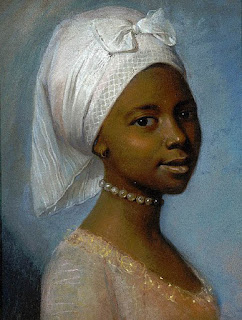
Portrait of a Young Woman - artist unknown, late 18th century                The blind spot in Native Son most discussed in class was that of the book’s representation of Bessie and black women as a whole, and whether this representation is effective in its depiction of the experiences of black women. To make a blanket statement, none of the women in Native Son are developed enough as characters to be depicted as full, well-rounded people. However, Bessie gets the brunt of this flat representation as she is objectified, dehumanized, and devalued by Bigger throughout the book, and then is literally treated as an object as her body is brought out as evidence in court for the murder of a white woman. I think it can be argued that there are reasons for this lacking depiction of Bessie, but I do not think that this novel is at all an effective representation of what it is like to be a black woman.        ...

Start of African American Lit. Posts

 From this point on all blog posts are related to African American Lit.

Free Will in The Plague

Image
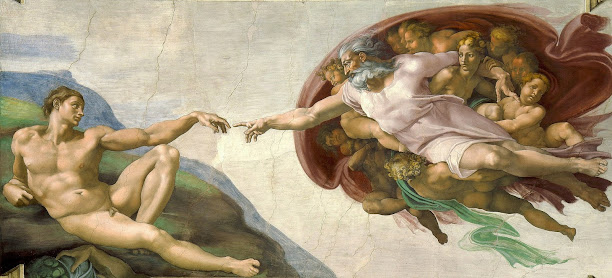
  The Creation of Adam by Michelangelo (c. 1508-1512) There have been many different responses to the plague. Some townspeople have chosen to essentially ignore it and wait for it to pass, some have decided to help fight the plague, and some have set their houses on fire. The way different characters have reacted reveal a lot about their worldviews. In Paneloux’s case, he has decided to give sermons about the plague, stating that the plague is part of God’s unwavering plan. Meanwhile Tarrou has set out to help the health committees control the spread of the plague, showing that he believes human efforts can save lives. I find Paneloux’s and Tarrou’s viewpoints particularly interesting, as they seem polarizing, and get into the question of whether the people on The Plague have free will. As Paneloux says in his sermons, he firmly believes that the plague is God’s will and that God’s will must be accepted in its entirety or fought in its entirety—there cannot be any middle ground. ...